Architectural Project 6

SHERIDAN COLLEGE
ARCH34231
Brampton
|
Architectural Project 6 |
|
SHERIDAN COLLEGE |
|
ARCH34231 |
Brampton |
MODULE #4B - Assessing the Condition of Woodframe Construction and the Code limitations of Combustible Construction
Learning Outcomes
"Some of Toronto's oldest buildings are constructed of wood. If properly detailed, in spite of its organic properties, wood can provide buildings with as long a reliable life as masonry construction. On the other hand, a wood frame (other than heavy timber) is classed as combustible construction. This module will look at how the condition of wood-frame should be evaluated AND will introduce you to the code limitations of combustible construction."
Contents : NOTE that this is a module which was developed around an earlier project, and while much does not relate to the current project, it represents a knowledge that will be useful in your assessment of other historic buildings.
1. Construction of Rackhouse J
 |
Rackhouse J is a brick building in which the roof structure is being borne
by the exterior masonry walls and internally by a heavy timber construction
(to be confirmed during our site visit). The roof deck above will likely be supported on wood joists (NOT HEAVY TIMBER). |
|
| This structure is therefore
considered to be a combustible structure with the accompanying code
limitations. The limitations on the quantity of combustible material permitted in a non-combustible building is clearly (or perhaps not so clearly) described in section 3.1.5 of the O.B.C. This includes paint, mastics and caulking; blocking within walls, some classifications of roofing, cant strips, and window sashes. |
 |
|
2. Typical Sources of failures in Wood Structure: Fungi and Rot
As an organic material, one of the greatest concern is that the wood has
been exposed to water. This moisture can have as its source:
|
|||
|
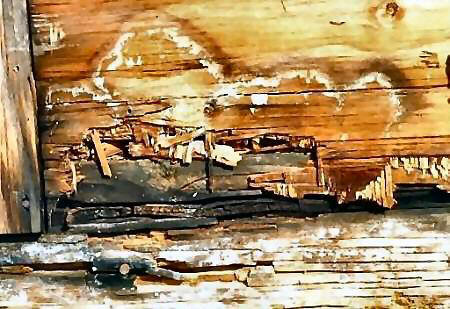
Staining or discoloration indicates that
members have been subjected to water and potentially high moisture contents
suitable for decay.
Rust stains from connection hardware are also a good indication of wetting. Since for rot to develop, a wood member must stay wet for a period of time, often the important areas to investigate are hidden. |
 |
||
|
Rot is a fungal growth that occurs when wood becomes damp. “Dry rot” is rotted wood that is no longer wet. Any wood that remains damp is at risk for developing rot. |
|||
|
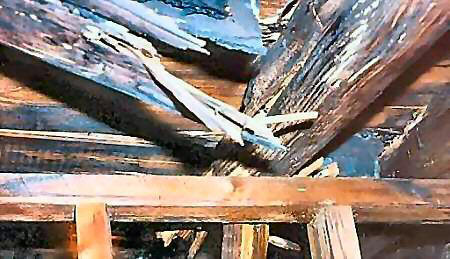
Fruiting bodies provide positive indication of fungal attack but do not indicate the amount or extent of decay.(Some fungi produce fruiting bodies after small amounts of decay have occurred; whereas others develop only after decay is extensive.) Sunken faces or localized surface depressions can indicate underlying decay. Decay voids or pockets may develop close to the surface of the member, leaving a thin, depressed layer of intact or partially intact wood at the surface.
|
 |
||
|
Plant or moss growth in splits, cracks, or soil accumulations on the structure indicates that adjacent wood has been at a relatively high moisture content suitable for decay for a sustained period of time. |
|||
| Recognize Wood Rots | |||
3. Typical Sources of failures in Wood Structure: Infestation
|
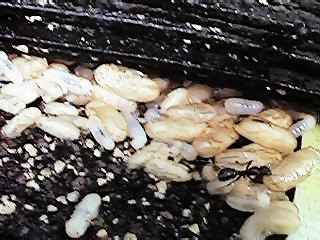
Two insects which are known to cause structural damage to wood are termites and carpenter ants. The presents of insects can also indicate the presence of decay. |
|
|
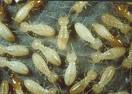
Termites are social insects that eat wood. There are two basic types of
termites, those that live entirely in wood, and those that can tunnel into
the ground.
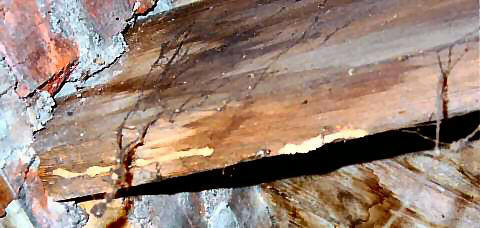
Among the wood inhabiting termites, there are various specialists such as rotten wood termites, damp wood termites and dry wood termites. Dry wood termites can be very serious pests of houses and furniture. Termite damage to structural members is not easy to observe. They feed inside the wood, along its softer parts. |
 |
 |
|
|
Most termites are the subterranean type and are able to tunnel in the soil.
The ability to tunnel allows them to find many separate pieces of wood, on
which to feed. Since they are not limited to one piece of wood, their
colonies can be much bigger than those of wood-inhabiting species.
Subterranean termites can be very serious structural pests of houses. Termites are present in large parts of Toronto, and spread rapidly. |
|
|
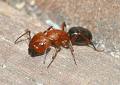
Carpenter ants do not eat wood, and generally are not as
damaging as termites. Carpenter ants use narrow, protected void areas for nests
and may be found in doors, window frames, and walls. At worst, carpenter
ants may, on occasion, cause minor damage to isolated pieces of wood. Because
carpenter ants are classified as wood-destroying insects, however, they are
reportable on real estate transactions and can affect the resale value of a
home. (Carpenter ants may also nest in foam insulation.)
This feature article from the CBC website may be of interest: Scourge of Carpenter Ants |
 |
 |
|
3. Typical Sources of failures in Wood Structure: Overstressed Members
| It is not usual to find that a building which has been standing for over a century to suddenly appear to be under-structured unless there have been significant changes to loads or adjacent new construction which might have undermined its foundations. Of course, "acts of God" like a tornado or an earthquake could similarly place new stresses on a stable structure. | |
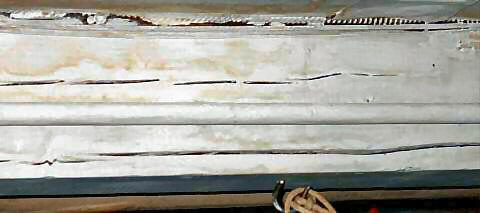 |
As timbers dry, they may shrink. This will not necessarily affect their strength, but the resulting cracks may be of concern to users. |
 |
|
5. OBC Classification for an Assembly Building of Combustible Construction
|
All occupied buildings need to be classified under 3.2.2. A building is classified on the basis of its principal or most demanding use. Your community centres will be considered to have an A-2 occupancy.
|
|
Under 3.2.2.28, a larger building area is permitted (4,800 m2 for one storey, or 2,400 for two storeys), but floors would require a fire-resistance rating of 45 minutes even if the building is sprinklered.
|
|
If you are able to classify under 3.2.2.25, the Community Centre would not have to be sprinklered, but the building area will be restricted depending on the number of "streets" serving the building and the number of storeys. A two storey building, considered to face two streets could not exceed 1,000 m2 in building area AND floors and roof would require a fire-resistance rating of 45 minutes. Roof rating is waved if the building is no more than one-storey and not larger than 1,000 m2
|