 Module
3 - Foundation SystemsModule
3 - Foundation Systems
Module
3 - Foundation SystemsModule
3 - Foundation Systems|
Module Objective The objective of this module is to provide detailed information on the requirements for concrete masonry block foundation system. A masonry foundation system is still use a poured concrete footing system. |
|
Module Outcomes By the end of this module the Learner will be able to:
|
Select Content From the Index Below or Scroll Down:

| Reading Preparation / Review | |
|
page 34-36 |
WebCT Site Canadian Wood-Frame House Construction |
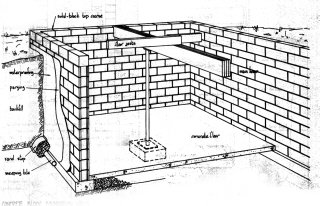
In some parts of Ontario concrete masonry block foundations are used in residential foundations.
Source: Illustrated Residential and Commercial Construction, by Peter Mann, page 5-12
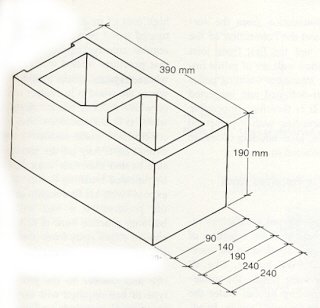
Concrete masonry block come in a variety of thickness and shapes as illustrated below.
Source: Canadian Wood-Frame House Construction, page 35
Masonry Block Shapes
Concrete Masonry blocks are available in a variety of shapes.
Source: Building Construction Technology, F. Hately, page 113
Masonry Concrete Blocks
Blocks are available in standard sizes however the length and height are standard:
- 15 5/8" (390mm) long x 7 5/8" (190mm) high.
The thickness vary from 3 5/8" (90mm) to 11 5/8" (240mm).
The foundation wall is used to carry the floor, wall, roof and other building loads (people, snow, wind, etc.), down to the footing.
Source: Canadian Wood-Frame House Construction, page 36
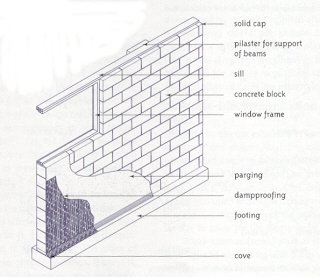
Foundation Block Wall
Concrete masonry block foundation wall is illustrated to the left.
Once the blocks have been installed parging can be placed over the blocks, following by the damproofing process.
Source: Illustrated Residential and Commercial Construction, by Peter Mann, page 5-12
Block Pattern
There are a variety of patterns, however the running bond illustrated to the left is the most common pattern used for foundations.
The running bond is an interlocking pattern of laying the blocks.
Source: Portland Cement Association
Masonry Layout
Corner of a masonry block foundation is laid out first, which is called a "lead corner".
Once the lead corners are completed at both ends, the remainder of the blocks are then filled in between the lead corners.
Source: Residential Building Methods, by V. Smith
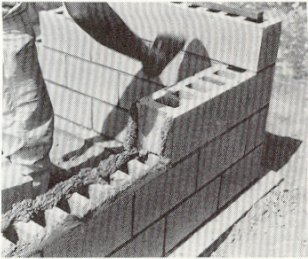
Masonry Mortar
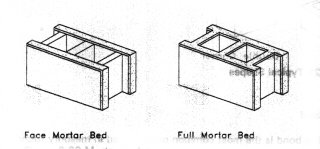
A masonry concrete block can have a face mortar bed or a full mortar bed as illustrated to the left.
Source: Residential Building Methods, by V. Smith
Mortar Joints
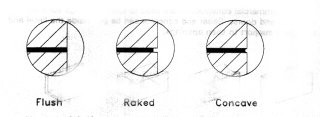
Mortar joints are usually 3/8" (10mm) in height. The face of the mortar joint will be tooled as a:
- flush joint
- raked joint
- concave joint
Source: Building Construction Technology, F. Hately, page 116
Anchor Bolts
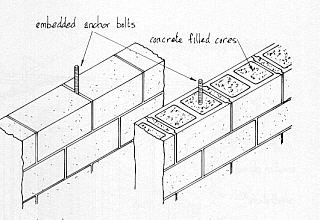
Anchor bolts can be embedded into the mortar of the concrete masonry block.
Review Questions |
|
| 1. | How are anchor bolts installed in a masonry foundation system? |
| 2. | What is the standard height and length of a concrete block? |
| 3. | What is the purpose of cement parging as used on a concrete block foundation wall? |
| 4. | What's the difference between damproofing and waterproofing? |
| 5. | Describe the various shapes of masonry concrete blocks? |