Sheridan College
Architectural Technology
ARCH29969 - STUDIO 3
MODULE 6: ONTARIO BUILDING CODE, PART 3: BUILDING DESCRIPTION AND OCCUPANCY
1.0 INTRODUCTION
1.1 History and Authority
Building Code Act is provincial legislation passed by the Ontario Provincial parliament. Previous to the Act there were a multitude of local municipal building codes that were different across the province. The creation of the Building Code Act was an attempt to obtain uniformity between municipalities. The Ontario Building Code (OBC) is a regulation made under the building code act. The OBC is based upon the National Building Code ( NBC ). The NBC is an attempt to unify the various building codes across the country.
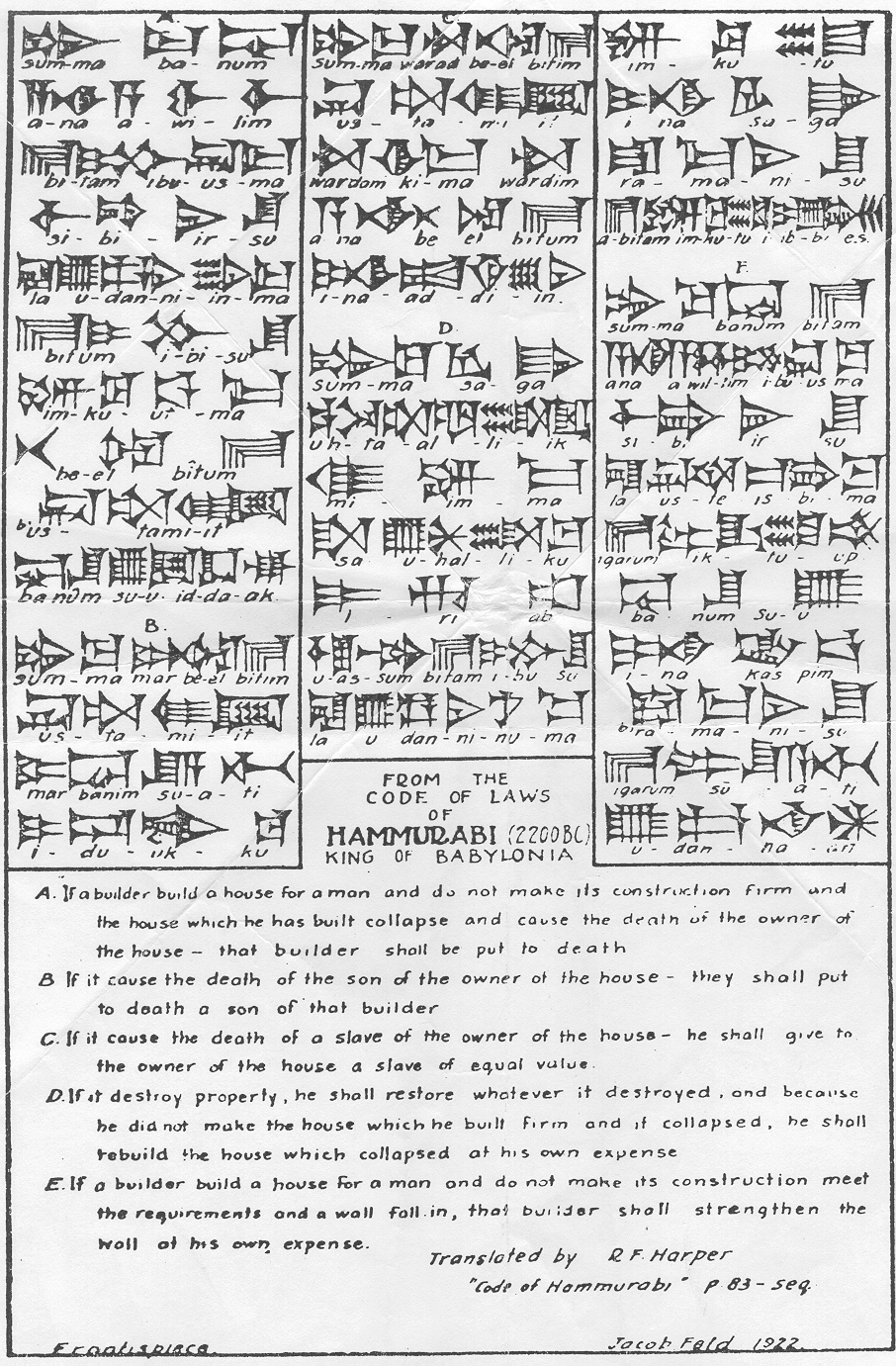
The first recorded building code?
1.2 Purpose
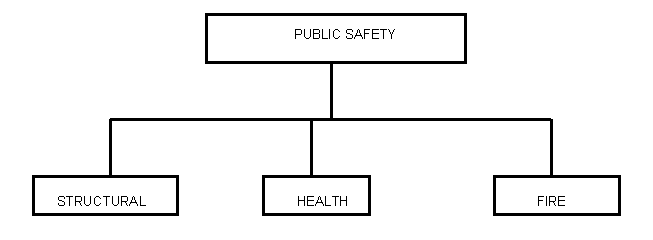
To promote public safety through the application of uniform building standards respecting minimum provisions regarding public health, fire protection, and structural sufficiency.
1.3 Organisation
The code has 12 ‘Parts’. Each individual provision is assigned a reference number in a decimal numbering system as follows:
OBC PARTS
|
|
| PART ONE
|
scope and definitions |
| PART TWO
|
general requirements: materials, reviews, permits, climatic data |
| PART THREE
|
use and occupancy: fire safety, fire fighting, exits, health, barrier free design |
| PART FOUR
|
structural design requirements |
| PART FIVE
|
wind water and vapour protection: heat transfer, air leakage, vapour diffusion, precipitation, surface water, moisture in the ground. |
| PART SIX
|
heating ventilating and air conditioning |
| PART SEVEN
|
plumbing: facilities, connections, materials, piping, drainage, venting |
| PART EIGHT
|
sewage systems |
| PART NINE
|
housing and small buildings |
| PART TEN
|
change of use |
| PART ELEVEN
|
renovation |
| PART TWELVE
|
transition between outgoing code and the new code January 1st, 2014. |
1.4 Current Events: The New 2012 OBC
1.4.1 Changes in the 2012 OBC
Click here for a downloadable PDF outlining the changes that are within the 2012 OBC. Most of these changes do not apply to what we are doing in this course.
2.0 OBC PART 3: BUILDING DESCRIPTION , USE AND OCCUPANCY
2.1 Presentation Material
2.2 Related Documents
2.2.1 Major Occupancy Classifications
Click here to download the Word document.
2.2.2 Use and Occupancy Worksheet
Click here to download the Word document.
2.2.3 Occupant Load Worksheet
Click here to download the Word document.
2.2.4 OBC Matrix
Click here to download the Word document.
2.3 In-class Exercises
Exercise #1: Definitions and Building Use
Exercise #2: Factors Affecting Safety of Building Users
Exercise #3: Determining Building Classification