 |
School: |
Applied Computing and Engineering Sciences (ACES)
|
| Faculty: |
Architectural Technology |
| Course: |
ARCH 12356 - Architectural
Studio 1 |
In-Class Exercise - Axonometrics
1
 |
PAGE CONTENTS
|
OBJECTIVES
- Resolve problems graphically
- Execute quality line work and lettering.
- Prepare sketches to specified scales.
- Prepare orthographic architectural drawings.
- Create sketch drawings using a variety of techniques
BACKGROUND
Architectural drafting involves the sketching of objects using 3-dimensional
projection techniques. The creation of axonometric drawings is explored and
practised in this exercise.

Consider the following:
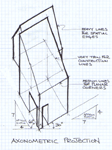
- Axonometric drawings are typically projected from a rotated plan view -
A 60/30 degree rotation is typical
- Axonometric projection does not distort the plan view - length and width
of an object are true measurements from the plan.
- Axonometric projection does not distort heights - heights are measured vertically.
- When using squared paper, the ratio of seven squares to 4 squares approximates
a 30-degree angle. The ratio of 4 squares to 7 squares approximates a 60-degree
angle.
- Use very thin line weight for construction lines.
- Use heavy line weight for spatial edges (Where two planes meet - but when
you only see one of the planes)
- Use medium line weight for planar corners (Where two planes meet - and you
see both of the planes)
TASKS
Using a fine-tipped pen on squared paper, draw an axonometric view of the objects
that are illustrated in the following orthographic projection drawings:
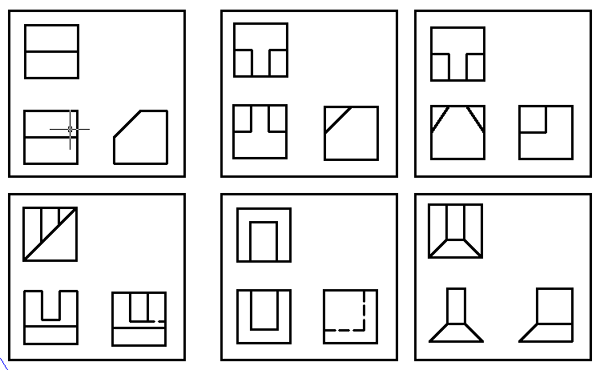
- The top three objects fit exactly inside a 6500 x 6500 x 6500 cube. Draw
the axonometric sketches at a scale of 1:100.
- The bottom three objects fit exactly inside a 35000 x 35000 x 35000 cube.
Draw the axonometric sketches at a scale of 1:500.
SUBMISSION REQUIREMENTS
- This is a freehand drawing course and consequently all line work MUST be
created using freehand sketching techniques. Drawings that incorporate ruled
lines (i.e. drawn with a ruler or other type of straight edge) will not be
evaluated.
- Use appropriate line weight and line type conventions as discussed in class.
- Be sure to include your name and class code (e.g. F120a or P03) on your drawings.
The drawing will be collected at the end of the class.
EVALUATION CRITERIA
This exercise is primarily to PRACTISE drawing neat, consistent and straight
line work. It will be evaluated for completeness only (i.e. Complete or Not Complete).
Top of Page