
Applied Computing and Engineering Sciences (ACES)
|
School: |
Applied Computing and Engineering Sciences (ACES) |
| Faculty: | Architectural Technology | |
| Course: | ARCH 12356 - Architectural Studio1 |
2-point Perspective Drawing - Sketch Techniques
 |
PAGE CONTENTS |
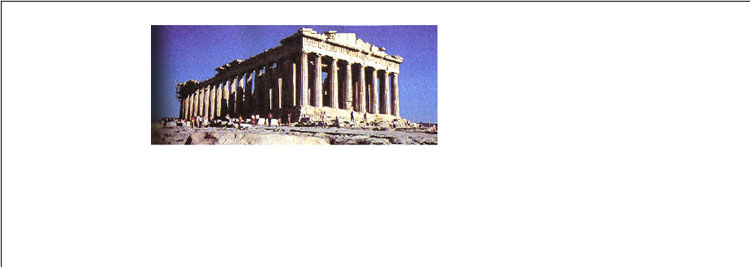
Image Source: Adapted from Residential Architecture: Design and Drafting by Ernest R. Weidhaas & Mark D. Weidhaas
2-point perspective drawing can be a very detailed, accurate and technical process - however this application is usually used for the preparation of final presentation drawings. The drawing techniques practised in this course are intended to develop 3-dimensional sketching and problem solving skills, not final presentation drawing skills.
Consequently, this module explores simple, quick visualization techniques to draw 3-dimensional objects, including buildings.

The Basic Building Block - THE CUBE
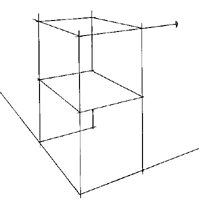
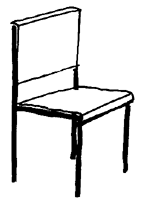
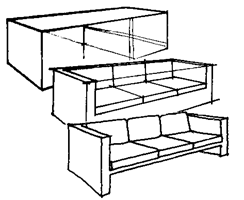
The key to quickly sketching 3-dimensional objects in perspective is to understand how quickly and accurately to draw a basic cubic form. Once this skill has been mastered, more complex objects can be constructed from a compilation of cubic forms.
 |
 |
 |
 |
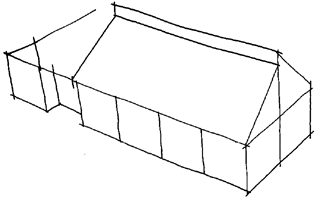 |
Image Source: Adapted from Rapid Viz: A New Method for the Rapid Visualization of Ideas by Hanks & Belliston
PERSPECTIVE SKETCHING TECHNIQUES
A. Recognizing a Square in Perspective
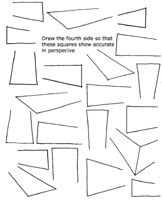 |
Print out the following sheet (Adobe Acrobat Reader required) and draw the fourth side of the squares so that they show accurate in perspective. Image Source: Adapted from Rapid Viz: A New Method for the Rapid Visualization of Ideas by Hanks & Belliston |
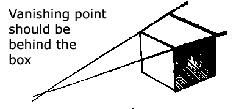
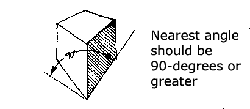
B. Key Principles of Perspective Drawing
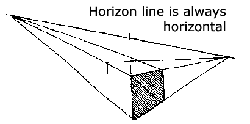
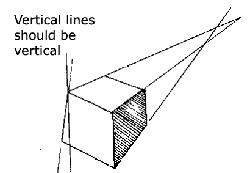
Some common drawing errors:
 |
 |
 |
 |
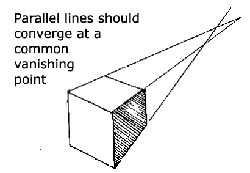 |
Image Source: Adapted from Rapid Viz: A New Method for the Rapid Visualization of Ideas by Hanks & Belliston
C. Recognizing a Cube in Perspective
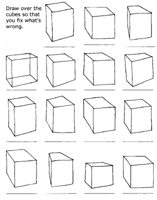 |
Print out the following sheet (Adobe Acrobat Reader required) and draw over the cubes so that you fix what is wrong. The cubes have at least one of four things wrong:
Image Source: Adapted from Rapid Viz: A New Method for the Rapid Visualization of Ideas by Hanks & Belliston |
D. Drawing 2-Point Perspective Boxes
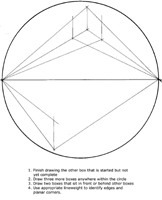 |
Print out the following sheet (Adobe Acrobat Reader required) and draw further cubes as directed. Image Source: Adapted from Rapid Viz: A New Method for the Rapid Visualization of Ideas by Hanks & Belliston |
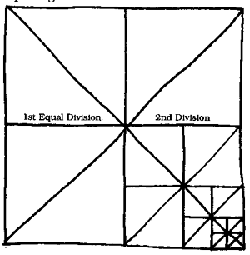 |
A square can be divided equally into smaller squares through using the diagonals |
 |
Similarly, a square drawn in perspective can be divided equally into smaller squares through using the diagonals |
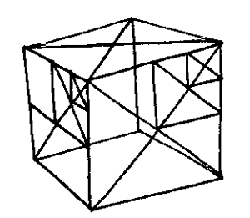 |
Similarly, a cube drawn in perspective can be divided equally into smaller cubes through using the diagonals |
Image Source: Adapted from Rapid Viz: A New Method for the Rapid Visualization of Ideas by Hanks & Belliston
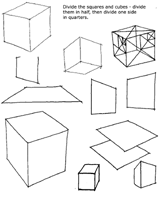 |
Print out the following sheet (Adobe Acrobat Reader required) and divide the cubes and squares as directed. Image Source: Adapted from Rapid Viz: A New Method for the Rapid Visualization of Ideas by Hanks & Belliston |
F. Proportion of Squares and Boxes
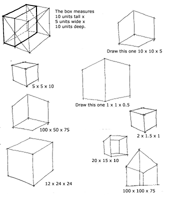 |
Print out the following sheet (Adobe Acrobat Reader required) and draw cubes of different proportions. Image Source: Adapted from Rapid Viz: A New Method for the Rapid Visualization of Ideas by Hanks & Belliston |
G. Multiplying Squares and Boxes
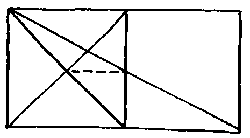 |
A square can be duplicated through using the diagonals |
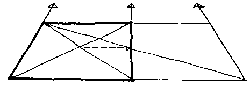 |
Similarly, a square drawn in perspective can be duplicated through using the diagonals |
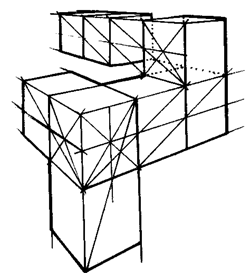 |
Similarly, a cube drawn in perspective can be duplicated through using the diagonals |
Image Source: Adapted from Rapid Viz: A New Method for the Rapid Visualization of Ideas by Hanks & Belliston
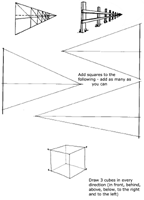 |
Print out the following sheet (Adobe Acrobat Reader required) and multiply the cubes and squares as directed. Image Source: Adapted from Rapid Viz: A New Method for the Rapid Visualization of Ideas by Hanks & Belliston |
Complete the six exercises indicated above.
The drawings will be collected at the end of the class.
This exercise is primarily to PRACTISE 2-point perspective sketching. It will be evaluated for completeness only (i.e. Complete or Not Complete).